Regular visitors to Fletcher Moss Park will know the WellBEEing Garden, near the entrance from Millgate Lane. This was designed as an accessible, peaceful space for visitors, and has been specially planted to attract pollinating insects such as bees and butterflies.
We often think of honeybees as living in colonies and producing honey, but over 90% of bee species in the UK are solitary bees, and they are vital pollinators for our native wildflowers and fruit trees. Each individual female builds and provisions her own nest, where her young develop over winter. Here we focus on two bee species recently identified in the Fletcher Moss Park and Parsonage Gardens.
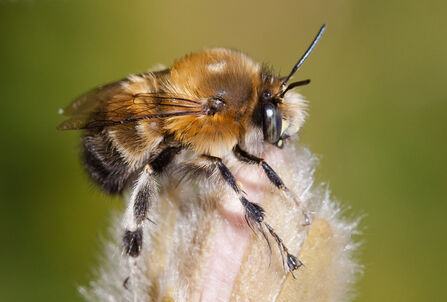
Hairy-footed flower bee (Anthophora plumipes)
The Hairy-footed flower bee is widespread in the South of the UK, but has been extending its range northwards, now including the Parsonage Garden, where it was first identified in 2025! It is active from March to June, where it can be seen hovering around plants such as cowslips, pulmonaria, red dead-nettle and comfrey. The males and females look completely different; the females are completely black, while the males are a sandy colour and have elongated middle legs with long hairs. These solitary bees do not build colonies. The females usually excavate nests in clay slopes and steep walls of mud, which they fill with pollen and nectar (food for the larvae) laying a single egg on each pollen mass.
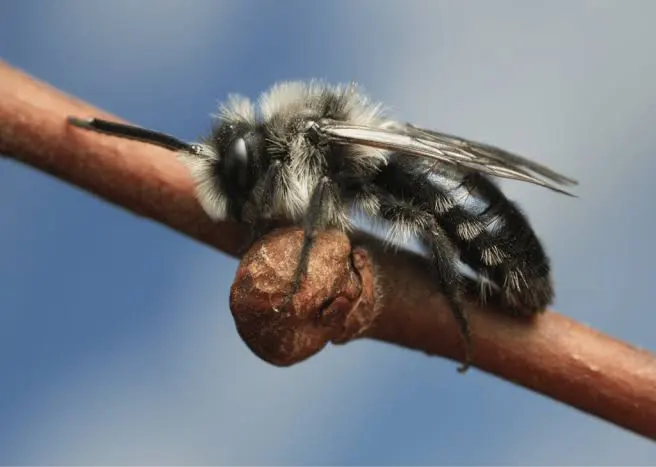
Ashy mining bee (Andrena cineraria)
With their distinctive black, grey and white colouring, Ashy mining bees are common throughout the UK except Northern Scotland. They prefer to nest in tended lawns, flowerbeds and parkland. They are solitary bees, flying from April until early June, most noticeably during the flowering periods of fruit trees, of which they are an important pollinator. They are also commonly seen hovering just above the ground after mating in spring. Following mating, the male dies and the female starts to build a nest. The nest is a simple burrow with several brood cells branching off it. The entrances to the burrows are identifiable by the conical mounds of excavated soil on the surface. The female fills the brood cells with a mixture of nectar and pollen, and lays one egg in each cell. The bees hibernate underground over winter, emerging as adults the following spring. They have been seen nesting in Fletcher Moss Park this year.
Anyone wishing to learn more about solitary bees in the UK might enjoy wildlife filmmaker Martin Dohrn’s film ‘My Garden of a Thousand Bees’, currently available on i-Player:
https://www.bbc.co.uk/iplayer/episode/m002t686/my-garden-of-a-thousand-bees